
Hello: Launching an MVP in Three Months
Built and launched a networking app MVP, then continued evolving it based on real user behavior.


Client
An entrepreneur and business coach. Networking and professional relationships are a core part of his work. He regularly attends industry events, where potential connections are everywhere. But in that flow of people, it’s difficult to quickly identify the right contacts and capture them before the opportunity is lost.
The client came up with a way to simplify this process by building an app that could automatically collect relevant contacts at events based on user-defined criteria such as company or role, while still respecting privacy.
This is how the idea for Hello came about—a networking app designed for entrepreneurs and executives.


Challenges
Building a complex product from scratch is always a risk, especially when it doesn’t directly generate revenue from day one.
In this case, Hello was a bet on an idea. Investing in the product meant putting personal time, money, and reputation into something that might not gain traction. The key question was whether the business model would hold or the product would stall after the first release.
We understood these risks and proposed a more controlled approach: starting with an MVP as an experiment. The idea was to test the core hypothesis with a small audience first and scale only what proved to work.
Starting with an MVP is not just about reducing costs. It’s a way to validate the idea with real users before committing to a full-scale product.

1. Automated Discovery
Finding the right professional contacts in a crowd of 200–300 people is time-consuming. It became clear that contact selection had to be automated and driven by user-defined criteria.
2. Expanding the Audience
Some users may want to keep part of their personal data private and share it only with a limited group.
This made it clear that the product had to support different visibility scenarios, including separate profile types with independent settings.
Development process
Basic Feature Set of Hello
In the first weeks, it became clear that the idea resonated with users: people started connecting not only at events, but outside of them as well. We tracked simple metrics—week-one retention, contact exchange rates, and Bluetooth usage—which signaled that the product was worth developing further.
Account
Sign up and log in. Create and manage both personal and business profiles.
Settings
Profile data. Notifications. Language selection. Profile visibility and active hours.
Smart Discovery
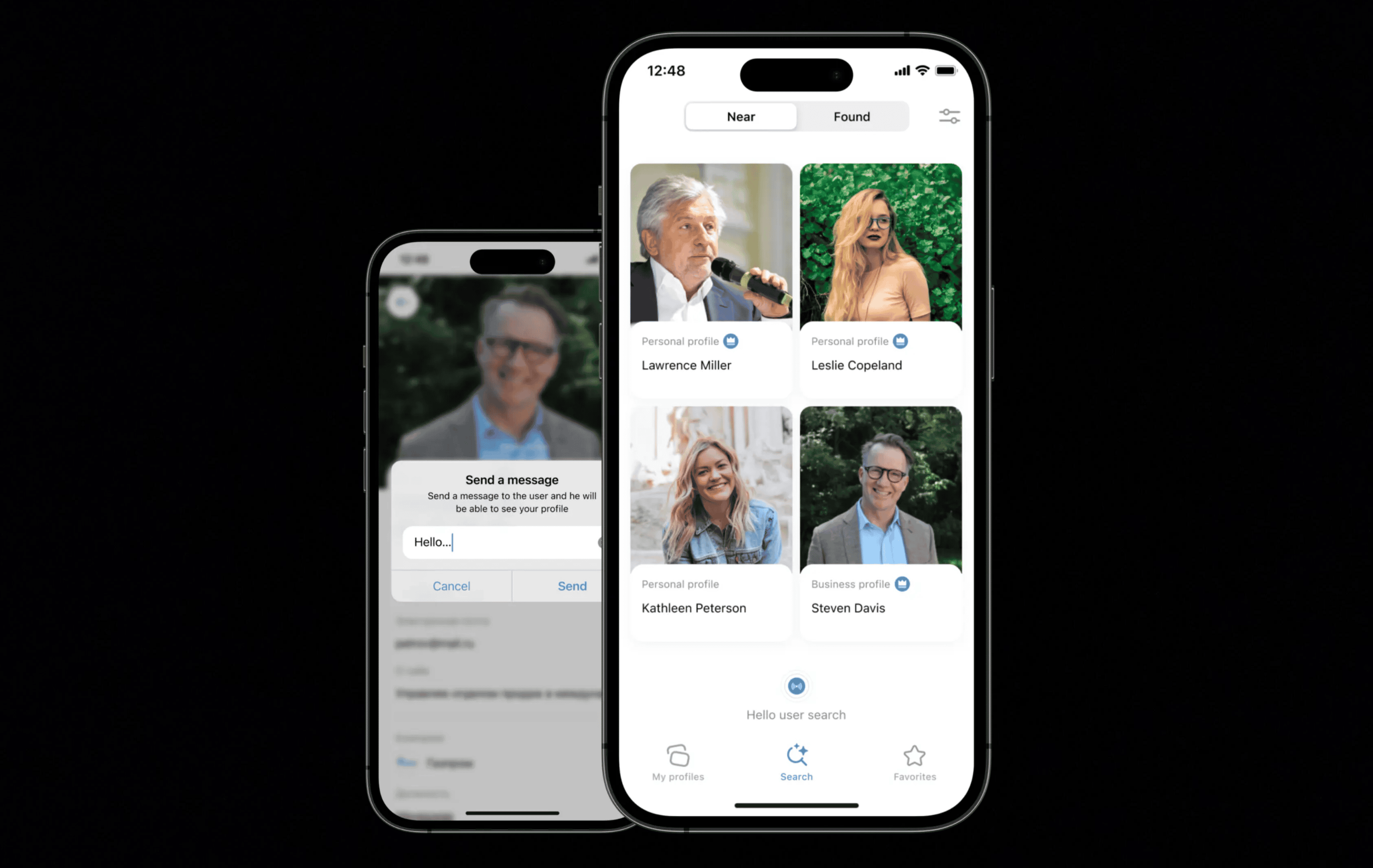
A list of nearby contacts matching user-defined criteria.
Push Notifications
Notifications when nearby users match the selected criteria.
From Idea to App Launch
1. Discovery Phase
– At this stage, we defined the core hypothesis: users are willing to connect and exchange contacts without lengthy onboarding or manual search—being nearby is enough.
– We set a goal to bring the product to market within six sprints.
– We mapped out the full feature scope and prioritized only the essential features for the first release, including:
• profile creation and editing
• discovering nearby users via Bluetooth
• push notifications and temporary storage of captured contacts
2. Team Setup
– The team was assembled around the task, without adding unnecessary roles. For the Hello MVP, we formed a compact team of four: a product manager, a designer, and two mobile developers (iOS and Android). The designer worked part-time, focusing on UI and user flows.
– Despite its size, the team functioned as a full project unit, with two-week sprints and continuous feedback from the product owner.
– This team setup was enough to bring a fully functional product to market, with clear logic, stable user flows, and readiness for scaling.
3. Native Development
Splitting development between iOS and Android was a deliberate decision. The goal was not just to build the product quickly, but to validate the core hypothesis without distortions.
The core functionality of the app was proximity-based user discovery via Bluetooth. The user experience depended directly on the stability of this feature. While cross-platform solutions can speed up development, in this case they introduced risks: OS-level limitations on iOS and Android, unstable Bluetooth behavior in the background, and delays in device detection. As a result, users could face inconsistencies in the core interaction.
At the same time, we balanced the potential increase in development cost through other decisions: we avoided building complex backend infrastructure at the start, used ready-made services, and kept the team lean.
4. Architectural Decisions
– The MVP was launched without complex server infrastructure. For authentication, data storage, and notifications, we used ready-made solutions (Firebase) to keep costs under control and validate the idea faster.
– After the hypothesis was confirmed, we brought in a backend developer (Go) to handle payments, privacy, and anti-spam.
– Go was chosen as a long-term architectural decision rather than a strict necessity at the MVP stage. This allowed us to lay the foundation for scaling early, so the product could evolve from MVP to a full-fledged service without major rework.
5. How It Works
– Users create a profile, adding contact details, a short description, photos, and links to social media or reviews, then launch the app.
– Hello detects nearby users. This works when other users have the app open and Bluetooth enabled.
– The app can notify users about relevant people nearby, if they allow such notifications.
– Users can create two profile types—personal and business—with independent visibility settings, activity hours, and field sets. Switching between them takes one tap, and users control when each profile is active.
– Blocking and reporting features are in place to filter out spam and unwanted contacts.
6. Automated Contact Capture
– Works when Bluetooth is enabled and the app is open.
– Data transfer is secure.
– By default, each detected profile appears in the “Found” list.
– Users mark relevant contacts, which are then moved to the “Saved” list.
– Contacts that are not saved are marked as temporary and automatically deleted after 24 hours, both on the device and on the server, to prevent storing personal data without user consent.
– Users can configure detailed visibility settings for both personal and business profiles.
Technologies

Backend
Firebase

Backend
Go

iOS
Swift

Android
Kotlin
Result
The idea of a contact-sharing app is not new. However, this was a case where starting with an MVP proved effective. In just three months, we moved from hypothesis to a working product, and early results showed that the idea resonated with users.
The idea resonated with professionals who rely on expanding their business networks at events. The app is also used by people who want to connect and introduce themselves in everyday life. With Hello, it becomes easier to find new contacts, friends, or people with shared interests.
The monetization model followed a standard approach. A paid subscription was planned from the start and introduced after the product validated demand. The Premium tier helps users save time and improves conversion to connections: for example, through profile customization, notification settings, blacklists, and more precise search filters (role, industry, company). It also includes saving contacts without a mutual match and additional privacy controls.
The client plans to continue developing the product: adding an in-app messenger to improve retention, GPS-based discovery, and QR-based contact exchange. A corporate version with CRM or CMS integration is one of the next steps under consideration.
to build the MVP and bring it to market.


of users saved at least one contact within three days.

What happens next:
Having received and processed your request, we will reach you shortly to detail your project needs.
After examining requirements, our analysts and developers devise a project proposal with the scope of works, team size, time and cost estimates.
We arrange a meeting with you to discuss the offer and come to an agreement.
We sign a contract and start working on your project as quickly as possible.